How Outsourced Accounting Services Improve Financial Accuracy and Visibility

Outsourced accounting services give growing businesses access to professional financial management, standardized processes, and consistent reporting without having to build an in-house team.

What Are Outsourced Accounting Services?

Outsourced accounting services are financial management solutions provided by an outside firm or team. The scope can include day-to-day bookkeeping, accounts payable, financial reporting, compliance support, and CFO-level guidance.

You can work with these providers remotely through cloud-based platforms. That setup lets you share data, review reports, and stay connected to your financial operations in real time. You get experienced support without the overhead of full-time staff.

Why Financial Accuracy and Visibility Break Down in Growing Businesses

Unreliable financial data is rarely the result of a single failure. In growing businesses, the root causes are usually process-related, and they compound. Manual processes introduce errors that accumulate across periods. A transaction miscoded in Q1 distorts profitability reporting through Q4, and tracing it back consumes time the team doesn’t have.

When sales data, payroll, and expenses sit in separate platforms, pulling a complete financial picture requires significant manual effort at every close. That effort introduces reconciliation gaps that are easy to miss and time-consuming to unwind.

Reporting latency compounds the problem. Financials that close two to four weeks after period end mean leadership is making current decisions on stale data, and that lag is structural, not a bandwidth issue that resolves itself as the team grows.

Without defined review and approval workflows, discrepancies go undetected until they surface as audit findings or compliance issues.

Growth often outpaces internal bandwidth, and when financial management turns reactive, accuracy is usually the first thing to slip.

How Outsourced Accounting Services Improve Financial Accuracy

Accuracy problems are often process problems. Outsourced accounting addresses them through standardization and consistent execution.

Established accounting procedures mean that every transaction is classified consistently, every account is reconciled on schedule, and every report follows the same format. That consistency reduces one of the most common sources of error: variability in how financial work is handled.

Reconciliations happen on a regular cycle, not just at year-end. Catching discrepancies within days rather than months keeps small issues from becoming costly corrections. Automation handles repetitive, high-volume tasks with more consistency than manual entry.

Multi-level review adds another layer of control. When one person enters the data, another reviews it, and a third approves it, errors are more likely to be caught before they reach final reports.

The result is financials you can trust. You get cleaner records, fewer restatements, and greater confidence heading into an audit.

Executive reviewing a financial analytics dashboard with KPI charts and forecasting metrics on a laptop in a modern corporate office.

How Outsourced Accounting Improves Financial Visibility

Accuracy is the foundation. Visibility is what you build on it. Outsourced accounting and bookkeeping services make financial performance easier to see and use.

Real-time reporting means you do not wait for a month-end package to understand where things stand. Current cash balances, open receivables, and expense trends are available when decisions need to happen.

KPI dashboards turn financial data into metrics that matter to your business, such as gross margin by product line, cash conversion cycle, and customer acquisition cost. Instead of sorting through raw numbers, you work with insights organized around your priorities.

Cleaner historical data makes forecasting more reliable. Cash flow projections, growth scenarios, and seasonal planning all depend on accurate records. With solid data behind them, these tools become far more useful.

Clear cash flow visibility reduces uncertainty. When you know when major payments are due, when receivables typically come in, and what your runway looks like, you can plan ahead instead of reacting to shortfalls.

Better visibility supports better decisions. That includes hiring tied to real revenue trends, inventory purchases based on actual demand, and pricing strategies grounded in true cost data.

Executive team reviewing real-time financial dashboards and business KPIs in a modern corporate conference room with a clean, high-end aesthetic.

Why Businesses Use Outsourced Accounting Services to Improve Accuracy and Visibility

When leadership, operations, and finance work with the same accurate numbers, the effects extend well beyond the accounting function. The financial close compresses from weeks to days, margin analysis becomes actionable, and overhead patterns that have drifted out of alignment with revenue become visible before they become problems.

Cost reductions tend to follow as a byproduct. Fewer errors reduce penalties, better cash visibility eliminates unnecessary borrowing, and stronger controls shrink compliance exposure without requiring a separate initiative.


For businesses in growth or transition, outsourced accounting scales with business needs rather than what an internal team can absorb, removing the hiring and onboarding lag that typically slows financial capacity.

Outsourced Accounting vs. In-House

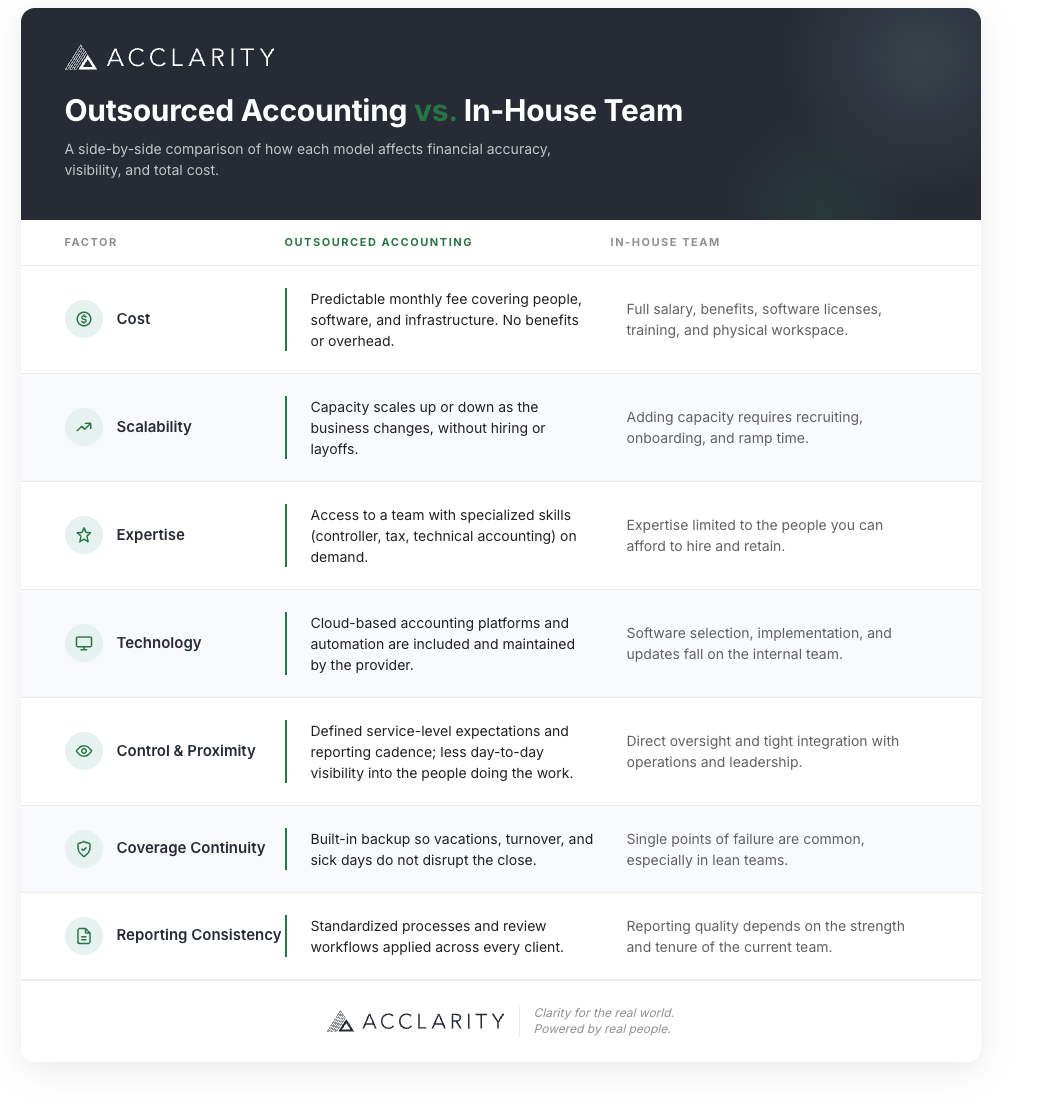
The right choice depends on your business, but the comparison is worth reviewing across the most important factors.

Side-by-side comparison of outsourced accounting versus an in-house accounting team across seven factors: cost, scalability, expertise, technology, control and proximity, coverage continuity, and reporting consistency.

For most small to mid-sized businesses, outsourced accounting delivers stronger visibility at a lower total cost. In-house teams offer direct control and close proximity, which can matter in complex organizations with heavy internal coordination needs. The key question is whether your current structure is actually giving you the accuracy and visibility your decisions require.

When to Outsource Your Accounting

Certain patterns show your current approach has reached its limit. Financial reports arrive late, forcing you to make June decisions based on April data. That is a structural issue, not a timing inconvenience.

You start to question your numbers. Meetings shift from strategy to fact-checking because the data needs verification. Variances between budgeted and actual results lack clear explanations, which signals a process gap that needs attention.

Cash flow remains difficult to see despite ongoing efforts. If it takes significant manual work to understand your current position, the visibility risk is real. At the same time, your team becomes stretched beyond its accounting capacity. Growth often outpaces internal bandwidth, and when financial management turns reactive, accuracy is usually the first thing to slip.

Each of these signs points to risk or missed opportunity. Addressing them early is almost always less costly than managing the downstream effects.

Frequently Asked Questions

What do outsourced accounting services include?

Most providers handle bookkeeping, accounts payable and receivable, bank and credit card reconciliations, payroll processing, financial reporting, and tax preparation support. Many also offer budgeting, forecasting, compliance support, and fractional CFO guidance, depending on your needs.

How do outsourced accounting services improve financial accuracy?

External providers bring standardized processes, scheduled reconciliations, and multi-level review procedures. Those controls reduce variability and manual errors that often arise in under-resourced internal setups. Consistent execution across accounting tasks is what produces reliable data.

Will outsourcing give me better visibility into my finances?

Yes. Cloud-based platforms give you real-time access to reports, dashboards, and key metrics instead of waiting for periodic updates. When the data is accurate and up to date, financial visibility becomes a practical decision-making tool.

How is my financial data kept secure?

Reputable outsourced accounting providers use encrypted platforms, role-based access controls, and secure data-sharing protocols. Look for providers that follow recognized standards like SOC 2, and that document their security practices in writing as part of the engagement.

What size business benefits most from outsourced accounting?

Small- to mid-sized businesses often see the greatest impact because they gain access to expertise and technology that would be difficult to replicate in-house at comparable cost. Larger organizations also use outsourced models for specific functions, especially when they need specialized coverage or faster capacity.

How do I choose the right outsourced accounting provider?

Look for industry experience, clear service-level expectations, and transparent communication and reporting processes. Ask how they handle errors, what technology they use, how they manage data security, and what the transition process looks like. References and a defined onboarding plan are strong signs of a professional operation.

Next Steps

Unclear financials are frustrating and create real decision-making risk. Outsourced finance and accounting services address the root causes, such as inconsistent processes, disconnected systems, and teams stretched beyond their accounting capacity.

The shift is from reactive to proactive. From questioning your numbers to trusting them. From month-old snapshots to current visibility that helps guide the next move. If you’re ready for that level of clarity, connect with an Acclarity finance expert and start building confidence in your numbers again.

Michele Himes is a Senior Managing Director at Acclarity. Michele is a seasoned CPA with more than 25 years of experience in audit, accounting, and consulting. She has advised organizations on best practices in internal controls, budgeting, forecasting, and process improvement. Her expertise spans managing Sarbanes-Oxley compliance, outsourced accounting, and business consulting projects across various industries.

Michele began her career at Deloitte & Touche in Columbus, Ohio, performing audits for SEC and privately held companies across multiple industries. She later transitioned to private industry, holding roles such as Accounting Manager, SEC Financial Reporting Manager, and Controller. Michele’s leadership extends beyond technical expertise—she is deeply invested in building strong client and team relationships. She has played a key role in recruiting, training, and developing talent while collaborating to implement standardized best practices and quality control for outsourced accounting services. Through her market leadership, Michele enhances Acclarity’s ability to deliver high-quality financial solutions to our clients.

Latest insights

Turning Material Weakness Into Momentum
Leadership, News 02.5.26

Turning Material Weakness Into Momentum

Material Weakness Remediation: From a governance, risk, and compliance (GRC) standpoint, material weaknesses offer an opportunity to realign controls and refine risk management frameworks.
Beyond the Checklist: The Hidden End-of-Year GRC Priorities That Will Define 2026
Leadership, News 12.18.25

Beyond the Checklist: The Hidden End-of-Year GRC Priorities That Will Define 2026

Beyond the Checklist: The Hidden End-of-Year GRC Priorities That Will Define 2026. As the year winds down, most Governance, Risk, Compliance, and Internal Audit organizations focus on familiar priorities. But the most significant risks rarely appear in year-end closeouts.
How to Know When Your Company Needs a Fractional Controller or Fractional CFO
Leadership, News 12.10.25

How to Know When Your Company Needs a Fractional Controller or Fractional CFO

How to Know When Your Company Needs a Fractional Controller or Fractional CFO

LET'S GET CLEAR.

Enough about us — we want to hear from you. Let’s connect.