Fractional CFO vs. Full-Time CFO: What’s Right for Your Business?

The right choice between fractional CFO services, an interim engagement, and a full-time hire depends on three things: the level of financial oversight you need, the complexity of your operations, and the investment that makes sense for your business.

Most growing businesses don’t need a full-time CFO. They need the right expertise at the right time. When that fit is right, the results show up quickly: more accurate financials, real-time visibility, and decisions made with confidence rather than guesswork.

What Is a Fractional CFO?

A fractional CFO is a senior interim or fractional finance leader engaged part-time, on a project basis, or through an ongoing retainer to provide strategic financial guidance without the commitment of a full-time hire. These professionals typically serve multiple clients at once, dedicating focused hours or days to each engagement.

Core responsibilities include:

  • Forecasting and financial planning & analysis (FP&A)
  • Cash flow management
  • KPI tracking and reporting
  • Strategic decision support

The engagement structure adapts to your needs. Some businesses bring in fractional support for a few days per month; others require intensive involvement during fundraising rounds, acquisitions, or periods of rapid growth.

The primary advantage is access. You get CFO-level expertise, strategic oversight, and financial leadership without the cost or overhead of a full-time executive hire.

Worth distinguishing: fractional CFO services are different from those of an interim CFO. An interim CFO is typically a temporary, full-time executive brought in to bridge a leadership gap (a sudden departure, a turnaround, a major transaction). A fractional CFO works on an ongoing part-time basis and isn’t tied to a specific event. Both models are alternatives to a permanent full-time hire, and the right fit depends on whether your need is event-driven or ongoing.

What Is a Full-Time CFO?

A full-time CFO is an executive employee who owns the entire finance function of an organization. Working exclusively for one company, this leader oversees everything from daily financial operations to long-term strategic planning.

Key responsibilities include:

  • Long-term financial strategy development
  • Finance team leadership and talent development
  • Internal and external reporting
  • Cross-functional executive collaboration

Full-time CFOs become deeply embedded in company culture over time, which creates real value in complex or fast-moving environments. This model works best for organizations where financial decisions arise daily and require consistent, senior-level attention.

Fractional CFO vs. Full-Time CFO: Key Differences

Here’s a side-by-side look at how the two models compare across the factors that matter most:

Cost Structure

Fractional CFO services operate on a variable cost model aligned to your actual usage. You pay for what you need, when you need it.

Full-time CFOs carry a fixed cost regardless of workload. Total compensation packages typically include base salary, bonuses, benefits, and equity, which together add up to significant annual overhead, whether or not your business demands that level of involvement.

Flexibility and Scalability

With a fractional arrangement, you can increase support during high-stakes periods, such as fundraising or audits, and scale back during steadier operations. The engagement adjusts to your business rhythm.

A full-time CFO is a fixed resource. That consistency has real value in certain contexts, but it also means you’re paying for availability even when the workload doesn’t justify it.

Speed to Impact

Fractional CFOs are built for fast starts. Because they regularly onboard into new businesses, most can begin contributing within days, not months.

Traditional CFO hiring typically takes three to six months, and that’s before onboarding. By the time a full-time hire reaches full productivity, a fractional engagement could already be delivering measurable results.

Expertise Access

Fractional CFOs bring cross-industry depth. Working across multiple companies and sectors exposes them to diverse financial challenges, which often translates into faster problem-solving and sharper thinking when it counts.

Full-time CFOs develop granular knowledge of one organization over time. That depth matters when institutional understanding is critical to decision-making at scale.

Integration Level

A fractional CFO operates as a strategic partner embedded in your business, functioning as an extension of your finance function rather than a distant consultant. They work alongside your team, inform leadership decisions, and stay accountable to outcomes.

A full-time CFO is present daily and involved across every part of the business. For companies where that level of constant involvement is essential, the fractional model has clear limits.

Most growing businesses don’t need a full-time CFO. They need the right expertise at the right time.

Where an Interim CFO Fits In

Some businesses need something between fractional and permanent: an interim CFO. This is a full-time, temporary executive brought in to cover a defined gap, typically during a CFO departure, a turnaround, M&A integration, or audit preparation. Engagements usually run three to twelve months and end when a permanent hire is in place or the project wraps.

The interim model is the right call when:

  • A CFO has suddenly left, and the business can’t operate without daily senior financial oversight while a permanent search is underway.
  • A complex transaction (acquisition, divestiture, or refinancing) requires the full-time attention of a CFO for a defined period.
  • A turnaround, restructuring, or rapid scaling event requires hands-on leadership before the long-term structure is settled.
  • The board or investors need experienced financial leadership in the seat now, while a longer-term plan takes shape.

Interim CFOs bring the same senior expertise as a permanent hire, but without the multi-year commitment or the lag of a traditional executive search. When the gap is defined, and the need is full-time, an interim is often the cleaner fit than either fractional or permanent.

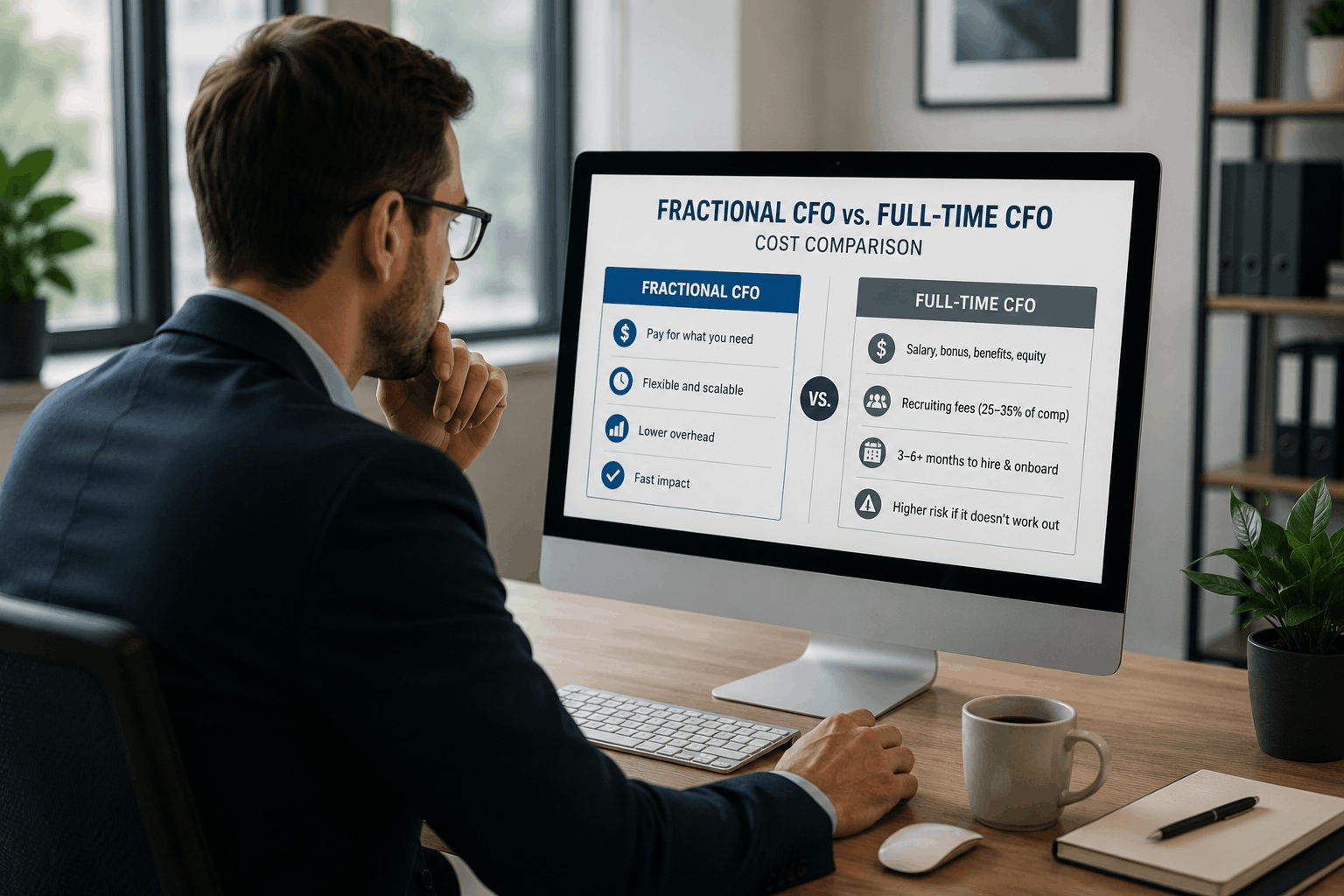
Business professional reviewing a fractional CFO vs. full-time CFO cost comparison on a desktop computer in a modern office workspace.

Fractional CFO vs. Full-Time CFO Cost Comparison

Cost is often where this conversation starts, and the difference is significant. Here’s how the two models typically compare:

Hidden Costs of a Full-Time Hire

The total investment in a full-time CFO goes well beyond the salary line. Executive recruiting fees alone can reach 25-35% of first-year compensation when working with a search firm.


Then there’s the time factor: months of interviews, negotiations, and onboarding before the hire is operating at full capacity. During that window, your business still needs financial leadership.

And if the placement doesn’t work out, which happens more often than most expect at the executive level, you’re looking at severance, a replacement search, and another ramp period on top of everything already invested.

The real cost difference between these two models is less about salary and more about utilization. Many businesses end up paying for full-time expertise they only need part-time.

When a Fractional CFO Is the Right Choice

The right time for fractional CFO support usually becomes clear once you know what to look for. These are the situations where it tends to deliver the most value:

  1. Your financial reporting is inconsistent or delayed. Reports arrive late, contain errors, or leave leadership questioning the numbers. Reliable, timely data is the foundation of every good business decision.
  2. You lack visibility into forecasting or cash flow. Without a clear view of where your finances are headed, strategic planning becomes guesswork. A fractional CFO builds the models and processes to change that.
  3. Your finance team has outgrown its strategic capacity. Your controller or bookkeeper is doing their job well, but the business has scaled past what they can guide alone. You need a senior voice at the table.
  4. A high-stakes event is on the horizon. Fundraising rounds, audits, acquisitions, and ownership transitions all require experienced financial leadership. These are exactly the situations where fractional support delivers outsized value. (If the event calls for full-time coverage on a temporary basis, an interim CFO can be the right fit instead.)

When the fit is right, the outcomes are concrete: faster decisions grounded in accurate data, stronger visibility across the financial function, and a finance capability that scales with your growth.

Fractional CFO advisor meeting with a business owner to review financial reports and growth metrics in a modern office setting.

Why Many Businesses Choose Fractional CFO Services

The growth of fractional financial leadership isn’t a trend. It reflects a practical shift in how businesses think about expertise, cost, and the right structure for each stage of growth.

A few reasons the model resonates:

  • No hiring delays. Pressing financial challenges can be addressed now, rather than waiting months for a search process to close.
  • Right-sized investment. Rather than committing to a $400,000+ annual package, you invest proportionally to your actual needs and stage.
  • Scalable support. During fundraising or major transactions, you increase engagement. During steady-state operations, you scale back. The model bends to your business, not the other way around.
  • Proven approaches applied quickly. Fractional CFOs have solved similar problems before. They arrive with frameworks and real-world experience that shorten the time to results.

At Acclarity, our fractional and interim CFO engagements are built around direct access to senior leaders. There are no junior handoffs or layered delivery models. You work with experienced professionals who are invested in your outcomes from day one. 

Get in touch today to begin the conversation.

FAQ: Fractional CFO vs. Full-Time CFO

Is a fractional CFO cheaper than a full-time CFO? Yes, typically by a significant margin. Full-time CFO total compensation, including salary, bonuses, and benefits, often reaches $300,000 to $500,000 or more annually. Fractional engagements are structured around your actual usage, making them a more capital-efficient option for businesses that don’t need constant CFO-level oversight. That said, cost alone shouldn’t drive the decision. The right model is the one that provides the financial leadership your business actually needs.

Can a fractional CFO replace a full-time CFO? For many small to mid-sized businesses, yes. A fractional CFO provides the same strategic financial leadership, advisory capability, and decision-making support as a full-time executive, without the overhead. Companies with highly complex operations, multiple entities, or those on an IPO path typically need the consistent presence and deep organizational integration a full-time CFO provides.

What’s the difference between a fractional CFO and an interim CFO? A fractional CFO works on an ongoing part-time basis, often across multiple clients, providing strategic leadership scaled to your needs. An interim CFO is a full-time, temporary executive who fills a defined leadership gap, typically during a CFO transition, turnaround, or major transaction. Acclarity offers both, depending on what your business needs.

How do I know which model is right for my business? Start with an honest look at how often your business needs senior financial input. If you need strategic guidance but not daily oversight, fractional services are likely a strong fit. If you have a defined leadership gap to bridge for a fixed period, an interim engagement may be the cleaner answer. If financial decisions arise constantly, you’re managing complex cross-functional operations, or you need someone embedded across the business, a full-time hire is probably the better path.

What are the main differences between the two? The core differences are time commitment, cost, availability, and depth of integration. Fractional CFOs provide part-time strategic leadership with cross-industry experience at a fraction of the cost of a full-time CFO. Full-time CFOs offer constant availability, deeper company-specific knowledge, and full integration into the executive team.

When should I hire a full-time CFO? A full-time CFO is typically necessary when your operations become complex enough to require daily senior financial oversight. That often means managing multiple business units or international locations, meeting significant regulatory requirements, preparing for an IPO, or building out a larger finance organization that needs consistent, on-the-ground leadership to develop well.

The Right Model Is the One That Fits Where You Are

The full-time vs. fractional CFO decision isn’t about which model is objectively better. It’s about which one fits where your business is right now.

For most growing companies, flexible and right-sized financial leadership delivers more value than a fixed executive hire. You get the expertise without the overhead, and the ability to scale support as your needs evolve.

When you’re ready to get clear on the right model for your business, we’re here.

Let’s get clear. Talk to an accounting advisory partner who can help you choose the right path forward.

Michele Himes is a Senior Managing Director at Acclarity. Michele is a seasoned CPA with more than 25 years of experience in audit, accounting, and consulting. She has advised organizations on best practices in internal controls, budgeting, forecasting, and process improvement. Her expertise spans managing Sarbanes-Oxley compliance, outsourced accounting, and business consulting projects across various industries.

Michele began her career at Deloitte & Touche in Columbus, Ohio, performing audits for SEC and privately held companies across multiple industries. She later transitioned to private industry, holding roles such as Accounting Manager, SEC Financial Reporting Manager, and Controller. Michele’s leadership extends beyond technical expertise—she is deeply invested in building strong client and team relationships. She has played a key role in recruiting, training, and developing talent while collaborating to implement standardized best practices and quality control for outsourced accounting services. Through her market leadership, Michele enhances Acclarity’s ability to deliver high-quality financial solutions to our clients.

Latest insights

Internal Audit Gaps Don’t Stay Hidden for Long
Leadership 05.28.26

Internal Audit Gaps Don’t Stay Hidden for Long

Internal Audit Gaps Don’t Stay Hidden for Long
How Outsourced Accounting Services Improve Financial Accuracy and Visibility
Leadership, Strategic FP&A 05.14.26

How Outsourced Accounting Services Improve Financial Accuracy and Visibility

Outsourced accounting services give growing businesses access to professional financial management, standardized processes, and consistent reporting without having to build an in-house team.
Turning Material Weakness Into Momentum
Leadership, News 02.5.26

Turning Material Weakness Into Momentum

Material Weakness Remediation: From a governance, risk, and compliance (GRC) standpoint, material weaknesses offer an opportunity to realign controls and refine risk management frameworks.

LET'S GET CLEAR.

Enough about us — we want to hear from you. Let’s connect.