
Interactive prototype - click a persona below to see the experience change

Why Most AI Pilots Stall Before Value Realization

There is no shortage of AI pilots. Organizations have tested meeting assistants, document generation, knowledge search, analytics, workflow automation, and increasingly, agents that can complete multiple steps across a process.

Many of those pilots produce encouraging results. Yet a surprising number never move beyond a small group of enthusiastic users.

The problem is not always technical. A pilot proves that a tool can do something under controlled conditions. Value realization requires the organization to make that capability repeatable, governed, supported, and worth the effort at scale.

That path from interesting to operational is where many initiatives stall, and it is where the most common AI adoption challenges appear.

Business Process Mapping and Workflow Planning

A Successful Pilot Is Not a Scalable Initiative

Pilots are intentionally forgiving. The scope is narrow. Participants are motivated. The team can work around imperfect data or access issues. Exceptions are handled manually. Senior attention helps remove obstacles that would slow a normal rollout.

Those conditions are useful for learning, but they can create a false sense of readiness. When the pilot expands, the organization encounters a different reality: more users, more data, more exceptions, more support needs, and greater consequences when something goes wrong.

Leaders need two separate decisions. The first is whether the capability works. The second is whether the organization is prepared to operate it. Treating those as the same decision is one reason pilot portfolios grow while realized value remains limited.
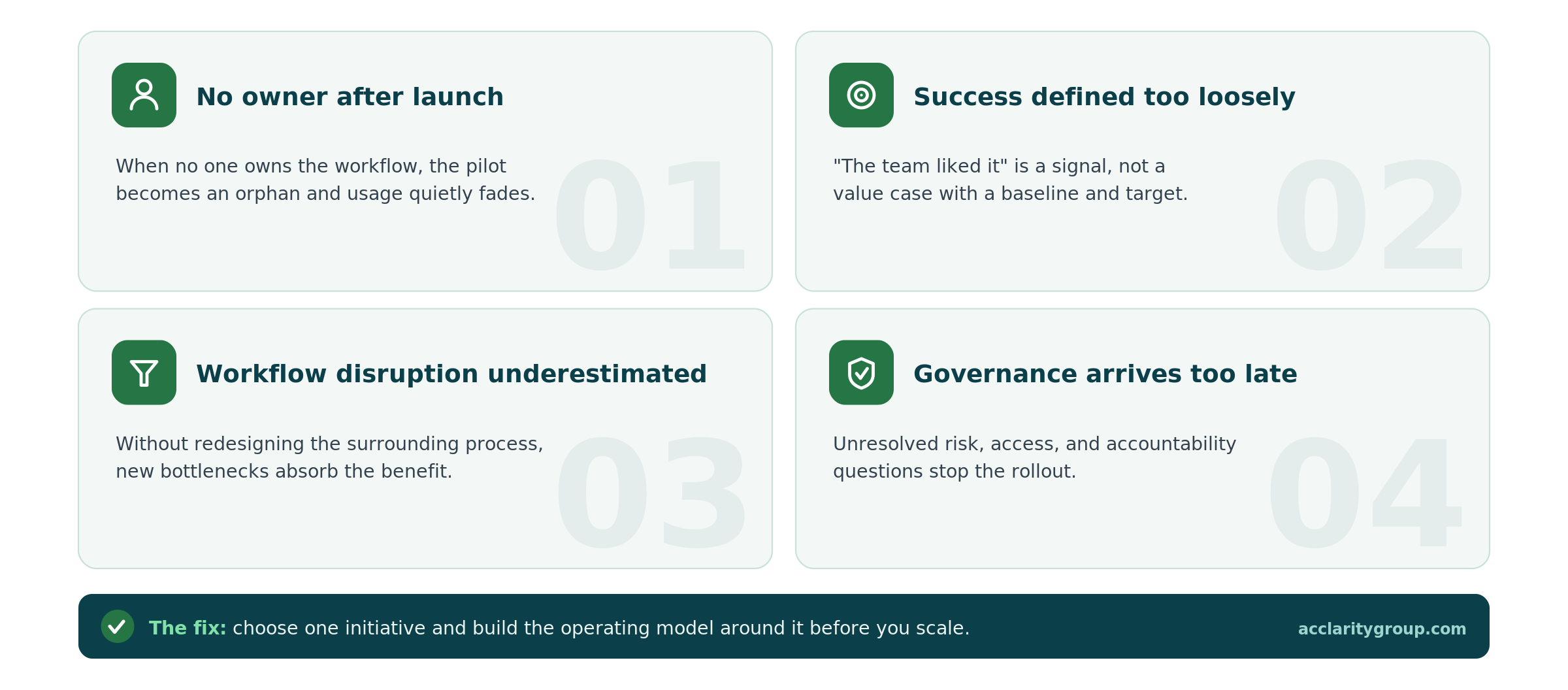

Four Failure Patterns Behind AI Adoption Challenges

Infographic showing four failure patterns behind stalled AI pilots: no owner after launch, success defined too loosely, workflow disruption underestimated, and governance arriving too late.

  1. No owner after launch: Innovation teams can coordinate a pilot, but someone must own the workflow after the excitement fades. Who maintains the source content? Who updates the instructions when the process changes? Who manages access, handles questions, tracks performance, and decides whether a new use case belongs in scope? Without an operating owner, the pilot becomes an orphan. Usage declines or fragments into individual workarounds.
  2. Success is defined too loosely: “The team liked it” and “the output looked good” are useful signals, but they are not a value case. A scalable initiative needs a baseline and a clear target: cycle time, review effort, backlog reduction, increased coverage, faster response, fewer handoffs, or improved consistency. The measurement should capture net results after corrections and exceptions, not just the speed of the first draft.
  3. Workflow disruption is underestimated: Even a capable tool changes roles and handoffs. It may shift work from preparers to reviewers, increase the number of exceptions reaching a specialist, or create a new dependency on data and access teams. If the organization does not redesign the surrounding process, the benefit can be absorbed by new bottlenecks.
  4. Governance arrives too late: Data handling, acceptable use, human review, logging, vendor risk, and accountability are often deferred during experimentation. When leaders finally prepare to scale, unresolved governance questions stop the rollout. Governance introduced early does not need to be heavy. It needs to be proportional to the risk and clear enough that the pilot tests the conditions that will exist in production.

Stop Treating Every Pilot as a Future Program

One lesson from our own experimentation was that continuing to test everything was not a strategy. We had to distinguish between use cases that deserved deeper investment and those that had taught us enough.

This is where portfolio discipline matters. Every pilot should end with one of four decisions:

  • Scale: The use case has demonstrated value and has a credible operating path.
  • Refine: The opportunity remains strong, but a specific constraint must be addressed.
  • Hold: The timing, technology, data, or organizational readiness is not yet sufficient.
  • Retire: The use case does not justify further investment.

Retiring a pilot is not failure. It is a sign that the organization is converting experimentation into judgment. The greater risk is allowing low-value pilots to consume attention while high-potential workflows remain underfunded.

Choose a Lighthouse With Business Weight

When organizations are ready to move, a lighthouse initiative can concentrate leadership attention and build reusable capability. The best lighthouse is not necessarily the flashiest. It has a meaningful business problem, an executive sponsor, accessible data, a definable quality standard, and a measurable workflow.

Good candidates often sit where friction is already visible: customer onboarding, internal audit planning, policy research, management reporting, client deliverables, or recurring reconciliations. The use case should matter enough to justify cross-functional effort but remain focused enough to manage.

Going all in does not mean removing controls or expanding to every user at once. It means giving the initiative clear ownership, a cross-functional team, agreed measures, and a staged rollout plan.

Install a Governance Framework Before the Wave Hits

Organizations do not need a complex AI council to approve every prompt. They do need a structure that coordinates business, technology, security, data, legal, and talent decisions for material use cases.

A practical AI governance framework should establish:

  • Risk tiers for different use cases
  • Approved tools and data-handling rules
  • Required human review by output type
  • Ownership for models, sources, integrations, and workflows
  • Measures for quality, adoption, cost, and value
  • A process for incidents, exceptions, and continuous improvement

This structure should make safe decisions faster. If governance only adds delay without clarifying accountability, it needs redesign too.

Move From Proof to an Operating Plan

Most AI pilots do not stall because the technology is weak. They stall because the organization has not built a path from proof of concept to operational value.

That path requires leaders to make decisions that pilots can postpone: which use cases matter, who owns them, how value will be measured, what risks must be controlled, and what work needs to change.

If your organization is sitting on a growing list of pilots, do not launch another one until you have reviewed the portfolio. Capture the lessons. Retire what will not scale. Choose the initiative with the strongest business case and build the operating model around it.

You do not need more proof that AI can produce output. You need a plan for the work you are prepared to change.

Sitting on a growing list of AI pilots? Get in touch with the Acclarity team to build the operating plan behind your next initiative.

LET'S GET CLEAR.

Enough about us — we want to hear from you. Let’s connect.

Latest insights

Human Intelligence in a Governance World: Why People Still Matter Most
Leadership, News 08.4.26

Human Intelligence in a Governance World: Why People Still Matter Most

The Human Factor: The Real Engine of Governance, Risk, and Compliance (GRC)
Acclarity Recognized by Honda with Prestigious Outstanding Value Supplier Award
News, Press Release 06.18.26

Acclarity Recognized by Honda with Prestigious Outstanding Value Supplier Award

The 2026 Outstanding Value Supplier Award recognizes Acclarity's commitment to value, innovation, and operational excellence in support of Honda's North American business operations
Internal Audit Gaps Don’t Stay Hidden for Long
Leadership 05.28.26

Internal Audit Gaps Don’t Stay Hidden for Long

Internal Audit Gaps Don’t Stay Hidden for Long