
Interactive prototype - click a persona below to see the experience change

From Prompting to Production: What We Learned Taking AI From Demos to Real Workflows

Over the last several months, one of the most useful shifts in our AI and data intelligence work has been moving from demonstrations to real workflow testing. That is where an AI adoption strategy gets more honest.

In a controlled demo, a tool like Codex can look almost magical. It can analyze files, draft content, modify work products, and move through a multi-step task faster than a person working manually. In a live operating environment, however, a different set of questions matters: Does the output fit the workflow? Does the quality hold up? Can the work be reviewed efficiently? And does the speed translate into measurable value after rework, exceptions, and human oversight are considered?

That distinction matters because production value is not created by output alone. It is created when the tool reduces effort inside a real process without creating new friction downstream.

Real Workflows Reveal Whether Your Process Is Ready for AI

Testing an AI tool in live workflows quickly reveals whether the surrounding process is ready for it. The strongest results tend to occur when five conditions are already present: a clear objective, organized source material, a known output standard, an identified reviewer, and an owner who is responsible for what happens next.

Where those conditions are weak, the model often gets blamed for problems that are actually operational. It is one of the most common reasons AI rollouts fail. If source documents conflict, the output will inherit the conflict. If “good” has never been defined, review becomes subjective. If no one owns the final decision, the work can move faster and still go nowhere.

This is why prompt quality, while important, is only one part of the equation. A strong prompt can clarify the goal, context, constraints, and definition of done. It cannot repair an undocumented process, reconcile business rules no one has agreed on, or decide who is accountable for a material conclusion.

Professional Legal Document Review and Note-Taking

Designing Human Review Into the AI Workflow

Human review cannot be treated as a final checkbox. It needs to be designed alongside the AI-enabled workflow.

Different outputs require different review standards. A first draft of a marketing post may need tone and message review. An audit memo may require evidence tracing, professional judgment, and confirmation that the conclusion is consistent with methodology. A financial analysis may require reconciliation to source data, formula validation, and approval by the appropriate business owner.

Before moving a workflow into production, leaders should define:

  • What must be verified every time?
  • Which exceptions require escalation?
  • What evidence should be retained?
  • Who is authorized to approve the final output?
  • How will reviewer feedback improve the next run?

The goal is not to review every AI-generated word forever. The goal is to understand the risk of the output, establish the right control points, and reduce unnecessary review as the workflow becomes more stable and measurable.
Measure Net Throughput, Not Visible Speed

AI tools generate visible output quickly, which makes speed the easiest benefit to notice. But gross speed is not the same as net throughput.

A workflow that saves 30 minutes in drafting but adds 45 minutes of correction has not created value. Neither has a process that produces more work than the review team can absorb. The right measures look beyond generation time and examine the full operating cycle:

  • Total time from request to approved output
  • Review and rework time
  • Frequency and severity of exceptions
  • Consistency against the agreed standard
  • Adoption by the people expected to use the workflow
  • Business impact, such as faster reporting, improved coverage, or reduced backlog

These measures help leaders distinguish an impressive demonstration from a repeatable capability. They also reveal where the next improvement belongs. Sometimes the answer is a better instruction. Sometimes it is cleaner source data, a narrower scope, a different review sequence, or a decision to retire the use case.

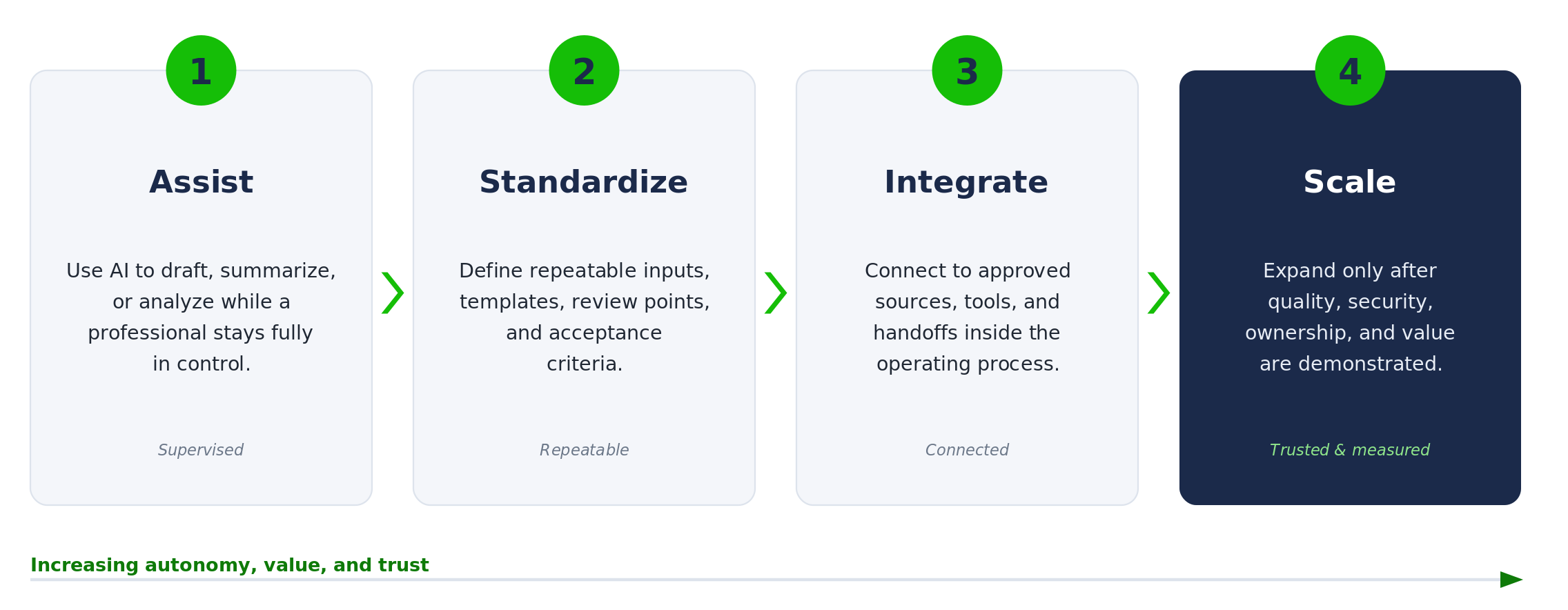
A Staged AI Adoption Framework: Assist, Standardize, Integrate, Scale

Acclarity's staged AI adoption framework: Assist, Standardize, Integrate, and Scale

The most reliable path from prompting to production is staged. Start with a contained task where the output standard is visible, and the consequences of error are manageable. Document the workflow before automating it. Test normal cases and exceptions. Capture reviewer feedback. Then decide whether the process is ready to expand.

A practical progression is:

  1. Assist: Use AI to draft, summarize, organize, or analyze while a professional remains fully in control. Contained tasks like using ChatGPT for accounting are a good place to start.
  2. Standardize: Define repeatable inputs, instructions, templates, review points, and acceptance criteria.
  3. Integrate: Connect the work to approved sources, tools, and handoffs inside the operating process, the same discipline behind sound AI and process automation.
  4. Scale: Expand usage only after quality, security, ownership, and value are demonstrated.

Not every workflow needs to reach the fourth stage. Some will create meaningful value as supervised assistance. The leadership responsibility is to choose the appropriate level of autonomy rather than treating full automation as the only sign of progress.

The Real AI Production-Readiness Question

Codex and similar tools can open new productivity channels. But the lesson from using them in real workflows is that model capability is rarely the only constraint. Workflow clarity, source readiness, review design, access, ownership, and measurement determine whether the capability can be trusted and repeated.

If your team is exploring where AI belongs in day-to-day execution, move beyond counting prompts or celebrating isolated outputs. Identify one workflow with a clear business problem, define what good looks like, and measure the entire path to an approved result.

The question is no longer simply, “What can the tool produce?” It is, “What are we prepared to operate?”

Ready to put an AI adoption strategy to work in your operations? Get in touch with the Acclarity team today.

LET'S GET CLEAR.

Enough about us — we want to hear from you. Let’s connect.

Latest insights

The Operating Model Behind a Winning Enterprise AI Strategy
AI Adoption 09.22.26

The Operating Model Behind a Winning Enterprise AI Strategy

AI productivity depends less on the tool than the operating model around it. Here are the conditions, ownership, and review design that turn AI pilots into repeatable enterprise capability.
Why Most AI Pilots Stall Before Value Realization
AI Adoption 09.15.26

Why Most AI Pilots Stall Before Value Realization

Most AI pilots stall before delivering value. Here are the four failure patterns behind common AI adoption challenges, and how to move from proof of concept to real operating results.
Human Intelligence in a Governance World: Why People Still Matter Most
Leadership, News 08.4.26

Human Intelligence in a Governance World: Why People Still Matter Most

The Human Factor: The Real Engine of Governance, Risk, and Compliance (GRC)