
Interactive prototype - click a persona below to see the experience change

The Operating Model Behind a Winning Enterprise AI Strategy

When leaders talk about AI productivity, the conversation often starts with the tool. Which model is strongest? Which platform has the most features? Which vendor can demonstrate the fastest result?

Those questions matter, but they rarely explain why one team captures repeatable value while another remains stuck in experimentation. In practice, the bigger difference is the operating model around the technology, and it is the foundation of any durable enterprise AI strategy.

AI amplifies the environment it enters. When work is clear, information is accessible, review happens at the right stage, and accountability is visible, productivity gains are easier to realize. When processes are fragmented, or ownership is unclear, AI can produce more output without improving the business result.

The hidden productivity engine is not the model alone. It is the system of decisions, roles, standards, and feedback that allows the model to be used well.

Business Process Mapping and Workflow Planning

Productivity Begins With Workflow Clarity

Many organizations try to automate a process before they have agreed on how the process should work. Different teams use different templates. Business rules live in email threads or in the experience of one employee. Exceptions are handled informally. The final standard is understood by reviewers but never documented.

AI does not remove this ambiguity. It exposes it.

Before introducing AI, leaders should be able to describe the workflow in plain language: What triggers the work? What inputs are required? What decisions are made? What does an acceptable output contain? Where do exceptions go? Who owns the final result?

This does not require documenting every keystroke. It requires enough clarity for the organization to distinguish the standard path from an exception and to determine where AI can reduce effort without weakening control.
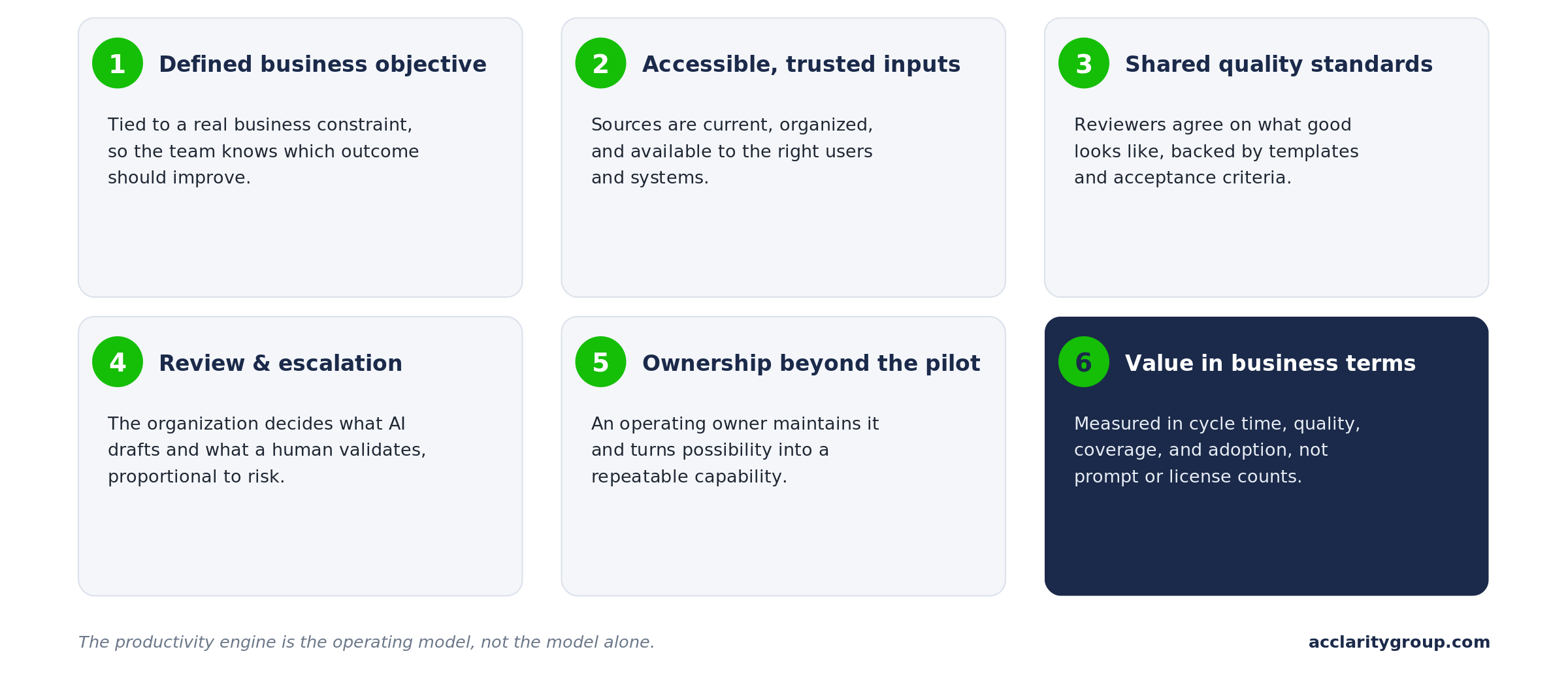

Six Conditions Behind Durable AI Productivity Gains

Six Conditions Behind Durable AI Productivity Gains

When AI creates sustained productivity, several operating conditions are usually in place.

  1. A defined business objective: The use case is tied to a real constraint: a reporting backlog, slow research, inconsistent documentation, limited audit coverage, or excessive manual reconciliation. The team knows which problem it is solving and which outcome should improve.
  2. Accessible and trusted inputs: The source material is current, organized, and available to the right users and systems. If teams spend more time finding, cleaning, or reconciling inputs than the AI saves, the business case will remain weak.
  3. Shared quality standards: Reviewers agree on what good looks like. Templates, examples, policies, and acceptance criteria give the tool and the people around it a common target. Without this, every output becomes a new debate.
  4. Intentional review and escalation: The organization has decided what the AI may draft or recommend, what a human must validate, and which exceptions need specialist review. Oversight is proportional to risk rather than applied inconsistently.
  5. Ownership beyond the pilot: Someone is accountable for maintaining instructions, source content, access, user support, performance measures, and change decisions. A pilot team can prove possibility. An operating owner turns possibility into capability.
  6. Value measured in business terms: Success is measured through cycle time, review effort, quality, coverage, adoption, and business outcomes. Counting prompts, licenses, or generated documents may indicate activity, but it does not establish value.

An Enterprise AI Operating Model Is Cross-Functional

AI initiatives often begin in technology, innovation, or a motivated business team. They rarely stay there.

A scalable workflow may involve business owners who define requirements, IT teams who manage integration and access, security teams who evaluate exposure, legal or compliance teams who set boundaries, data owners who maintain sources, and reviewers who remain accountable for the output. Human resources and learning teams may also need to redefine roles and build new skills.

If these responsibilities are not aligned, the gaps emerge later as delays, duplicate controls, inconsistent adoption, or unresolved risk. The solution is not a large committee for every use case. It is a clear decision structure.

For each meaningful AI workflow, leaders should know:

  • Who sponsors the business outcome?
  • Who owns the workflow day-to-day?
  • Who owns the data and access decisions?
  • Who sets the review standard?
  • Who decides whether the workflow expands, changes, or stops?

Visible decision rights create speed. Ambiguous governance creates meetings.

Scaling AI Requires Process Redesign

One of the easiest mistakes is to insert AI into an existing process without reconsidering the process itself. A tool drafts faster, but the same approvals remain. More analyses are produced, but the reporting cadence does not change. Documentation is automated, but reviewers still examine every line because the control design was never updated.

Real productivity often requires redesigning the handoffs around the tool. That may mean moving review earlier, eliminating duplicate formatting, using standardized source packages, creating risk-based review tiers, or changing who performs the first analysis, the same discipline behind effective AI and process automation.

The best question is not, “Where can AI do this step faster?” It is, “If this capability existed from the beginning, how would we design the workflow?” That question opens the door to operating leverage rather than isolated time savings.

Build the AI Operating Model, Then Improve It

The operating model does not need to be perfect before teams begin. It needs to be explicit enough to learn responsibly.

Start with one valuable workflow. Define the objective and owner. Organize the sources. Establish an output standard and review path. Measure the full cycle. Use feedback to improve both the instructions and the process. Then decide what should scale, the same move from prompting to production that separates isolated wins from repeatable capability.

Over time, the organization can reuse common components: approved tools, access patterns, review standards, risk tiers, training, measurement, and governance. That is how scattered experiments become an enterprise capability.

The most important AI productivity engine in your organization may not be the model itself. It may be the operating model that determines whether the model can be trusted, repeated, and improved.

If productivity gains remain inconsistent, look beyond the tool. The constraint may be the environment you are asking it to work within.

Ready to build an enterprise AI strategy that scales? Get in touch with the Acclarity team.

LET'S GET CLEAR.

Enough about us — we want to hear from you. Let’s connect.

Latest insights

From Prompting to Production: What We Learned Taking AI From Demos to Real Workflows
AI Adoption 10.1.26

From Prompting to Production: What We Learned Taking AI From Demos to Real Workflows

Internal Audit Gaps Don’t Stay Hidden for Long
Why Most AI Pilots Stall Before Value Realization
AI Adoption 09.15.26

Why Most AI Pilots Stall Before Value Realization

Most AI pilots stall before delivering value. Here are the four failure patterns behind common AI adoption challenges, and how to move from proof of concept to real operating results.
Human Intelligence in a Governance World: Why People Still Matter Most
Leadership, News 08.4.26

Human Intelligence in a Governance World: Why People Still Matter Most

The Human Factor: The Real Engine of Governance, Risk, and Compliance (GRC)